
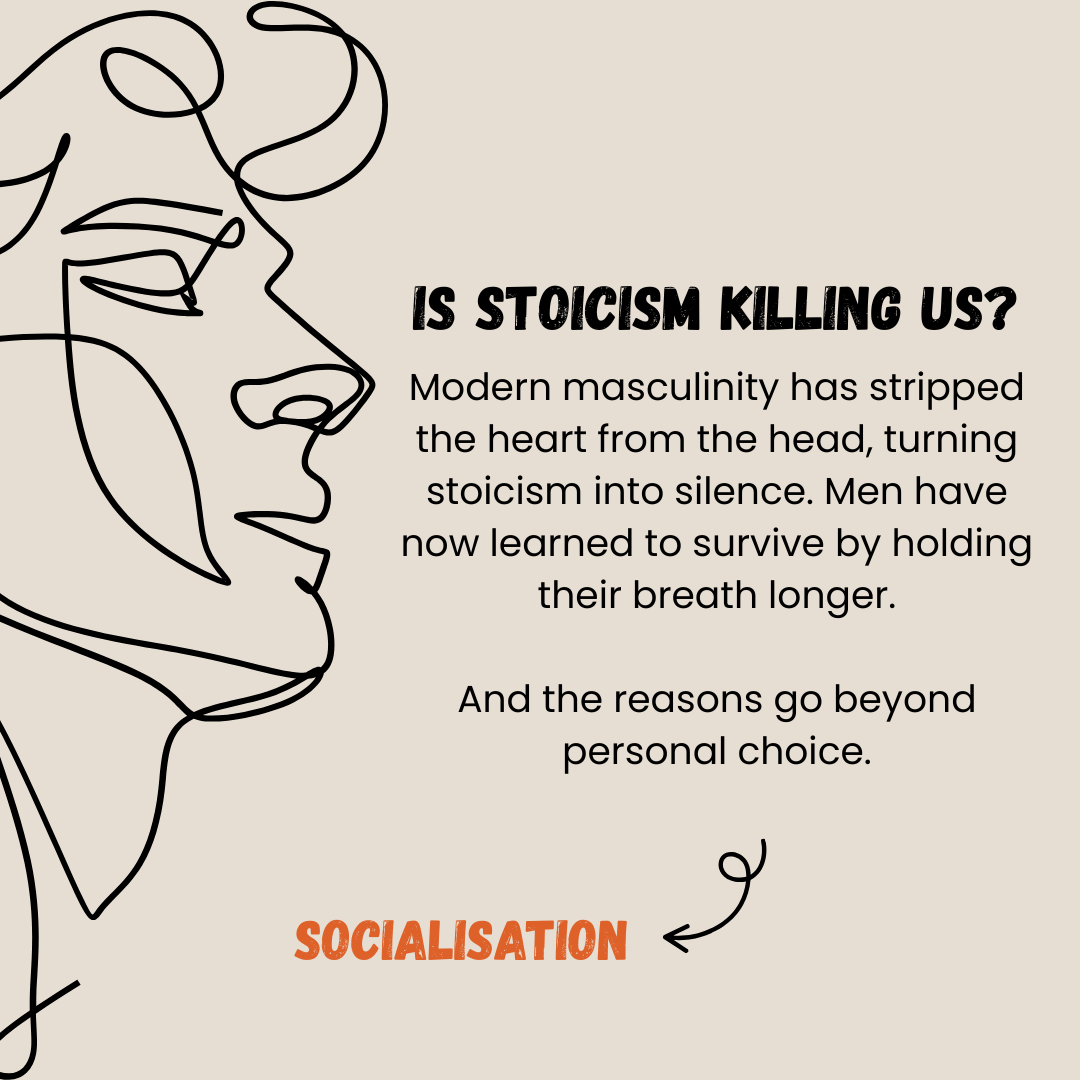
The Quiet Way Men Are Expected to Grieve
He’s the one who doesn’t cry at funerals.
He’s the friend who says, “I’m fine,” even when his world is falling apart.
He’s the colleague who never takes a mental health day.
He’s the partner who silently absorbs the pressure, never asks for help, and keeps smiling.
He is everywhere, and he is hurting.
In many conversations online, this figure feels familiar. People often describe a father, partner, or friend who “just carried on” after a loss: no tears, no conversations, only silence. It raises an important question on how men in Singapore are expected to handle painful events throughout their lives.
From a psychological perspective, this pattern is often linked to emotional suppression and what is sometimes referred to as normative male alexithymia; where individuals struggle to identify or express what they are feeling, even during significant moments like bereavement.
Then why are men waiting longer, speaking less, and suffering alone?
Somehow, modern masculinity stripped the heart from the head, turning stoicism into silence.
When Stoicism Turns Into Suppressed Grief
Why Many Men Grieve in Silence
In the context of grief, this silence is not accidental. It is shaped by years of conditioning, expectations, and internalised beliefs about what it means to “be strong.”
Emotional Suppression Is Often Learned Early
From a young age, many boys are taught directly or indirectly that emotional expression is something to control.
“Don’t cry.”
“Be a man.”
“Toughen up.”
Over time, these messages form a pattern of emotional suppression, where feelings are experienced internally but rarely expressed outwardly.
When grief enters later in life, this conditioning doesn’t disappear. It becomes the default.
Masculinity Shapes What Grief Is Allowed to Look Like
Modern society still clings to the image of the “strong, silent type.” Boys are told to “man up.” Tears are for girls. Emotional restraint is equated with maturity.
But this outdated blueprint of masculinity doesn’t leave room for grief, heartbreak, anxiety, or even joy expressed too loudly.
Behind the composed face, many men are silently grappling with depression, burnout, and loneliness. And because they’ve been taught not to name or share those emotions, they often don’t seek help until the pain becomes too loud to ignore.
And there are numbers to show for it as well. Globally, suicide rates among men are significantly higher than among women. In Singapore, as in many parts of the world, men are less likely to seek mental health support despite showing clear signs of psychological distress.
A 2024 study published in Psychiatry International explored the role of masculinity in male suicide and found that men who firmly adhered to traditional masculine norms were significantly more likely to experience suicidal thoughts or attempt and/or die by suicide.
Grief Is Often Suppressed or Difficult to Express
There is a quiet expectation that grief should pass quickly. That life should continue as normal.
But grief does not follow a timeline.
When it is pushed aside in the name of resilience, it often returns in subtler, heavier ways: sometimes months or even years later. What looks like coping can become what psychology recognises as complicated grief, where emotions remain unresolved beneath the surface.
At the same time, not all silence is intentional. Some simply do not know how to describe what they are experiencing.
“How are you feeling?”
“I don’t know.”
Rest assured, this isn’t avoidance. After all, it can be a genuine difficulty in identifying emotions, often linked to alexithymia. In grief, this may feel like confusion, heaviness without clarity, or even a sense of emotional blankness.
Silence Feels Safer Than Vulnerability, Even When It Isn’t
The “strong, silent type” is still widely admired.
Someone who carries on without complaint. Who doesn’t burden others. Who keeps everything together.
But in grief, this expectation reinforces silence.
What looks like strength externally may actually reflect grief avoidance: a way of coping by not engaging with the pain at all.
Even when the weight builds, many hesitate to reach out:
“I should be able to handle this.”
“It’s not that serious.”
These beliefs make silence feel like the safer option, even when it leads to isolation.
And when grief does surface, it often does so in ways that don’t look like grief at all, such as irritability, restlessness, or recklessly keeping oneself busy with work as a form of distraction.
These actions only serve to reinforce a negative cycle. if it doesn’t look like grief, it doesn’t get expressed.”
The Hidden Consequences of Unprocessed Grief
It is essential to acknowledge that repressed emotion doesn’t disappear; it festers. It shows up in chronic stress, aggressive outbursts, addiction, and numbness. Over time and left without counselling during bereavement, it affects the individual and the relationships they hold dear.
What Looks Like Strength Can Become Ongoing Strain
What we often interpret as strength: carrying on, staying composed, not talking about it, can come at a cost.
Because when grief is not processed, it does not resolve. It lingers.
What looks like “handling it well” can quietly turn into constant mental fatigue, restlessness and difficulty switching off.
What Isn’t Expressed Can Create Distance From Others and Yourself
- A father who cannot tell his child “I love you” because he never heard it himself.
- A partner who withdraws emotionally, not out of disinterest, but because vulnerability feels unsafe.
- A friend who stops responding, not out of neglect, but because he doesn’t know how to talk about what’s wrong.
When grief is kept inside, connection becomes harder. Over time, silence doesn’t just affect relationships with others. it creates distance within oneself, often showing up as a sense of disconnection.
Grief Returns in Other Ways When Avoided
Grief does not always come out as sadness.
When it has no outlet, it often finds one.
It can surface as sudden emotional reactions and outbursts, or a lingering sense that something isn’t right.
Pushed aside for too long, these negative emotions can resurface later, often heavier and harder to understand, what psychology recognises as delayed or complicated grief.
So what if we reimagined masculinity?
What if being a man meant being in touch with your emotions?
What if strength included knowing when to ask for support?
What if resilience meant bending instead of breaking?
Imagine a world where men speak openly about their therapy sessions, similar to how they talk about fitness routines, where a father hugs his son without awkwardness and the “you’ll be okay” is replaced with “I hear you. I’m here.”
Sounds good, right?
The best part is that such a change doesn’t require a grand revolution. It begins in small, conscious steps:
- Start by naming your emotions. Even just saying, “I feel overwhelmed” or “I’m not sure what this is, but it’s heavy” is powerful.
- Have one honest conversation. Open up to a friend, start speaking to a grief counsellor, or even a journal. Vulnerability isn’t weakness. It’s a bridge to connection.
- Model emotional courage. If you’re in a position to lead at home, at work, or in your community, create space for others to share, too.
- Challenge the myths. Call out phrases like “man up” or “real men don’t cry.” Language shapes culture.
- Seek support early. Therapy isn’t just for when things fall apart. It can be a place to understand, unlearn, and grow.
These steps may seem simple, but collectively, they’re how we begin to redefine strength.
You Don’t Have to Carry Grief Alone
To the men reading this: you do not have to hold it all together. You are allowed softness. You are allowed sadness. And above all, you are allowed to be human.
To the people around them: ask how they are… really. And when they hesitate, give them the safety to speak. Break the silence by meeting it with presence, not pressure.
Let us not lose more lives to emotional invisibility. Let us not worship stoicism at the cost of connection. Because being a man shouldn’t feel like walking through life in emotional chains.
It’s time we shift the narrative: from stoicism to wholeness, and from silence to voice.
For those who may not know where to begin, speaking to someone outside of your immediate circle can sometimes make that first step easier.
If you feel you need professional help and emotional support, please reach out to EMCC. Help is available, and hope is always within reach.
Exploring options for grief counselling in Singapore may provide a safe and structured space to better understand what you’re feeling, even if you’re not yet sure how to put it into words.