
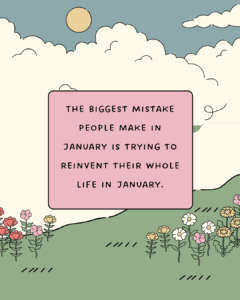
 January arrives in our country with the quiet authority of a school principal. New year, new goals, new identity. Suddenly, everyone is auditing their life as if it’s an annual performance review: career trajectory, relationships, body, bank balance, and emotional maturity. By the second week, many people feel like they’re already behind; behind an imaginary version of themselves who apparently woke up on January 1st with perfect clarity and colour-coded plans.
There’s a particular pressure here. Singapore doesn’t do things halfway. If we commit, we optimise. If we plan, we plan properly. The result is that January often becomes less about hope and more about correction. Who should I be by now? What am I doing wrong? Why does everyone else look like they’ve figured it out?
This is where identity quietly enters the room.
An identity crisis doesn’t always look dramatic. It often looks like scrolling at night and feeling oddly disconnected from your own life. It’s the sense that you’re playing a role you once chose or worse, one that was chosen for you but no longer recognise. New Year messaging can intensify this by suggesting that a “better” version of you is just one disciplined month away. As if identity is a software update you forgot to install.
Psychologically, this pressure makes sense. Humans love clean lines. We like before-and-after stories, fresh starts, tidy narratives. January offers a symbolic reset button, even though real change rarely respects calendar dates. Most meaningful shifts happen slowly and awkwardly, more like learning to balance on a bicycle than flipping a switch.
There’s also the false urgency effect. When a moment is framed as “now or never,” we overestimate how much must change immediately. January gets treated like the last train home. Miss it, and you’ve somehow failed the year. This creates anxiety, not momentum. People confuse motion with meaning—making changes just to feel like they’re not standing still.
For young adults especially, this can collide with a deeper question: Who am I becoming? In a society that values progress, stability, and achievement, uncertainty can feel like a personal flaw instead of a normal developmental phase. Many people assume that by their mid-20s or early 30s, identity should be locked in. In reality, identity is more like a working draft than a final submission.
Let’s simply put this through the renovation versus demolition metaphor. January often pushes demolition thinking: tear it all down, start again, be unrecognisable by March. Renovation thinking is quieter and less glamorous. It asks: what still works? What needs adjusting? What can stay, even if it’s imperfect? Renovation respects continuity. Demolition ignores the cost.
Psychology tells us that people change best through small, repeatable decisions, not grand declarations. So technically, identity isn’t built from resolutions; it’s built from patterns. What you return to when no one is watching. What you choose on an ordinary Tuesday. These are boring moments, which is why social media doesn’t highlight them, but they matter far more than January enthusiasm.
Another overlooked idea is identity lag. Sometimes your life circumstances change faster than your sense of self can catch up. You may have graduated, moved, started work, or become more independent, yet still feel strangely untethered. That doesn’t mean you’re failing. It means your internal story needs time to update. Forcing reinvention during this lag often creates confusion rather than clarity.
So what if January wasn’t about becoming someone new?
What if it was about staying in conversation with who you already are?
This doesn’t mean stagnation. It means curiosity without punishment. Reflection without panic. Allowing yourself to evolve without demanding a dramatic transformation on a fixed timeline. Growth doesn’t require a public announcement or a perfectly phrased intention. Sometimes it looks like noticing what drains you, what steadies you, and what you’ve been tolerating out of habit.
Singapore moves fast. It rewards efficiency and decisiveness. But humans are not systems to be optimised every quarter. You’re allowed to enter a new year unfinished. You’re allowed to not know yet. You’re allowed to carry parts of last year with you because not everything needs to be discarded to make room for what’s next.
January doesn’t need reinvention. It needs permission: to grow at a human pace, not a headline pace.