
How Jun Wei found clarity and steadiness after years of carrying stress alone.
Jun Wei, 28, is a teacher who had been quietly carrying work stress for several years. What began as internal pressure and self-doubt eventually manifested physically in his body. After three years of trying to cope on his own, three months of counselling helped him regain clarity, rebuild confidence, and feel steady again.
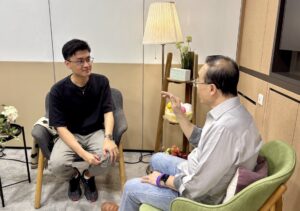
Q: What led you to seek counselling?
Jun Wei:
I’ve been working for about five years, and over time, the stress just accumulated. As I moved from job to job, I began noticing weaknesses in myself at work, things like poor boundaries and difficulty managing stakeholders.
I constantly felt pressured, and eventually, it started affecting me physically. Whenever I felt anxious or stressed, I would feel like vomiting. My stomach would churn constantly. That was when it dawned on me that this wasn’t something I could simply “push through”.
To be honest, I had already been considering counselling for about two years. But I kept questioning myself. I wondered, “Are my issues really serious enough? Am I just being too emotional? Am I blowing this out of proportion?”
I have a tendency to be very self-critical, so I kept minimising* what I was feeling. But once my body started reacting in ways I couldn’t ignore anymore, I finally decided to seek help.
*Minimisation is a cognitive distortion consisting of a tendency to present events to oneself or others as insignificant or unimportant. (APA Dictionary of Psychology)
Q: Did you have any hesitations before starting?
Jun Wei:
I did. I wasn’t sure who to trust, and I wanted my first counselling experience to be a good one.
I previously had an encounter with a practitioner in a medical setting that felt quite cold and dismissive, which made me cautious to continue seeking support. A friend of mine helped me by recommending EMCC and sharing something insightful.
He reminded me that counselling is a journey. A counsellor doesn’t have to solve everything in your life at once. If it’s a good fit, they walk with you for a season. If not, then it’s okay to move on. You’re not locked in.
That perspective made it feel less intimidating and gave me the courage to try again.

Q: What was your experience like in the counselling room?
Jun Wei:
From the moment I walked into the centre, I felt a sense of peace. I could relax here and it was comforting.
In the first session, I had to learn to trust the process. There’s a time limit, and I kept wondering, “How much should I share? If I talk too long, will there be time for him to respond?”
Eventually, I decided to let go and trust that the counsellor sitting across from me knew what he was doing.
By the second session, I could see how much thought my counsellor had put into what I shared. He came prepared. I could feel his heart, how he truly cared, and the observations he made from what I shared were very accurate.
At one point, he stood up and started mapping everything out on the whiteboard: my pain points, the people involved, the patterns behind my reactions. We weren’t jumping into the solutions yet, but it was like someone shining a light on where all the weight was coming from.
Finally, I understood why I felt so affected. And it was really helpful to just know the reasons why.
Q: Was there anything specific that helped shift things for you?
Jun Wei:
We used a technique involving guided eye movements, which is connected to how the brain processes memories.
It was a technique that seemed really simple, but in about 25 minutes, something shifted.
Before that, the memories I had of situations that brought me overwhelming stress and anxiety were vivid. I could almost hear the voices again and see everything clearly, triggering anxiety in me. But after that session, the memories felt neutral. The images were blurrier and these just became events that happened in the past, not experiences I was still reliving.
Now, when I see or speak to the same people who used to trigger stress, I no longer feel that underlying fear. It feels almost magical, but it worked.
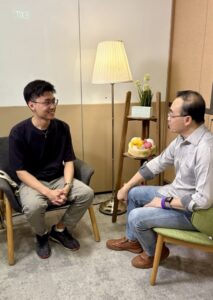
Q: Have you learnt anything new about yourself through counselling?
Jun Wei:
I realised that I tend to avoid conflict. When tension arises, my instinct was to de-escalate quickly and agree to whatever the other party wants to avoid their wrath. But that also meant that my own needs never made it to the table.
During counselling, we explored my anger management style more intentionally. We even did an assessment to identify it. What surprised me was learning that being avoidant isn’t necessarily right or wrong. It’s simply a management style.
Understanding that shifted something for me. Instead of attaching moral judgement to the way I respond, I began to see it as learning a new skill set — finding better ways to negotiate, to stand up for myself, and to respond more intentionally rather than automatically.
Q: How are you now?
Jun Wei:
I still interact with the same people who once caused me stress. But now, I can look at them, greet them, and hold a conversation without shutting down internally.
Previously, I felt like a deer caught in headlights. I would freeze and struggle to explain myself. There was always a sense that I was on the back foot.
Today, I feel steady. It’s not that everything has changed overnight, but I feel grounded in a way I wasn’t before. I genuinely feel like I’m back on my two feet and ready for the year ahead.
Q: You attended subsidised sessions. Did that make a difference?
Jun Wei:
Yes, it did, Though I was still willing to try counselling, cost was definitely on my mind when I first started since I was in between jobs.
Being able to receive the subsidies helped to reduce the barrier of entry for me significantly to get through a difficult period.
It was much-needed support at that time so I could get back on my feet.
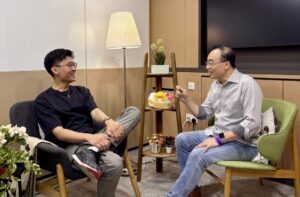
Q: What would you say to someone who is unsure about seeking help?
Jun Wei:
I struggled alone for about three years. But just three months of counselling helped me to bounce back.
Sometimes we struggle but tell ourselves to “just persevere, work on it, grind it out, and build character”. But instead of delaying the pain or waiting to hit rock bottom, we can allow ourselves to accept help earlier.
The people around us may care deeply, but they are not always equipped with the skills to help us untangle complex issues. Counselling gave me a structured, safe space to do that.
I truly hope that my painful three years can help and encourage someone else to seek help and healing sooner.
Counselling does not remove life’s challenges, but it can help us face them with greater clarity and equip us with the right tools to overcome them.
If you recognise parts of yourself in Jun Wei’s story, you do not have to navigate it alone. EMCC is here to walk with you, reach out to us now.