
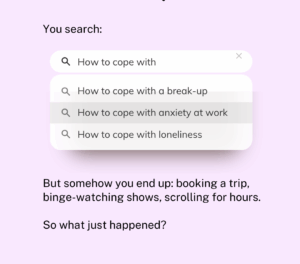
 It often begins with a search bar.
After a difficult week, someone types how to cope with anxiety at work.
After a relationship ends, they search how to cope with break-up.
On quieter evenings, the question might be how to cope with loneliness.
Reddit offers advice, checklists, and long explanations. But sometimes the answers feel too heavy to implement in the middle of a stressful day.
So instead, we escape.
A spontaneous holiday booking.
A weekend spent binge-watching entire seasons of a show.
Scrolling through social media until midnight.
None of these are inherently bad. In fact, the mind often looks for temporary exits when emotional pressure builds. The real question is whether escapism is helping you cope, or simply helping you postpone what needs attention.
To understand that difference, it helps to first look at the meaning of the coping mechanism itself.
“Coping Mechanism Meaning”: How We Deal with Emotional Stress
A coping mechanism is simply the way we respond when life becomes emotionally demanding.
Coping strategies can sometimes resemble cleaning a messy room.
Some approaches help you sort things out, like folding clothes, putting books back on shelves. Others involve pushing everything into a cupboard and closing the door.
The room looks tidy for a while. But eventually the cupboard becomes difficult to open. This is where psychologists often distinguish between emotion-focused coping and problem-focused coping.
Emotion-Focused Coping vs Problem-Focused Coping
Both strategies serve important purposes.
Emotion-focused coping helps regulate the feelings that arise from stressful situations. Examples include distraction, relaxation, journaling, or talking to a friend. Even activities like watching a show or going for a short trip can fall into this category.
In contrast, problem-focused coping addresses the situation itself. This might involve having a difficult conversation, setting boundaries at work, seeking guidance, or making practical changes to resolve a problem.
Escapism usually begins as emotion-focused coping. The brain is simply trying to reduce emotional discomfort quickly. And sometimes that’s exactly what we need.
But difficulties arise when escapism becomes the only response.
When Escapism Becomes Maladaptive Coping
The term maladaptive coping refers to strategies that provide short-term relief but create long-term difficulties.
Escapism can quietly fall into this category when it replaces rather than supports problem-solving.
For example:
- Taking frequent trips to avoid addressing relationship conflicts
- Immersing in gaming or streaming to escape loneliness after work
- Staying constantly busy to avoid thinking about a recent break-up
A useful way to think about escapism is this: it is like pressing the snooze button on an alarm.
Once or twice, it provides relief. But if the alarm keeps ringing and we keep hitting snooze, the original issue still waits for us.
Young professionals in fast-paced cities like Singapore often rely on quick forms of escape like weekend travel, digital entertainment, or constant activity. These outlets may provide short-term relief. But when they become the primary way of dealing with stress, emotional concerns remain unresolved beneath the surface.
Why Escapism Feels So Effective
Escapism works because it offers immediate emotional distance.
When we step away from a stressful situation, the brain experiences temporary relief. The nervous system settles, and the emotional intensity reduces.
In psychological terms, the mind prioritises short-term comfort over long-term resolution.
That is why someone searching for how to cope with anxiety at work might end up spending hours scrolling through social media instead. Or why someone researching how to cope with a break-up may suddenly decide to plan a trip.
The escape is not irrational… it is simply fast.
But sustainable coping usually requires something more balanced.
Moving Toward Healthier Coping Strategies
Instead of eliminating escapism entirely, the goal is to pair emotional relief with meaningful action.
A few helpful steps include:
- Notice what you are escaping from: Ask yourself what feeling or situation you are trying to avoid. Stress at work? Loneliness in the evenings? Unresolved relationship conflict?
- Allow emotion-focused coping in moderation: Distraction, rest, creativity, and leisure activities can be useful. They create space to think more clearly.
- Add problem-focused coping: Once emotional intensity reduces, consider addressing the source of stress directly. This might involve communication, practical changes, or seeking guidance.
- Reach out for support: Some concerns, such as persistent loneliness, work anxiety, or the emotional impact of a break-up, can be difficult to navigate alone.
Supportive conversations can make the path forward much clearer.
When Professional Support Can Help
If escapism has become a frequent way of coping, it may be helpful to explore what lies beneath that pattern.
A therapist can help identify:
- patterns of maladaptive coping
- emotional triggers behind avoidance
- practical strategies that combine emotion-focused and problem-focused coping
Over time, coping becomes less about escaping discomfort and more about responding to it with clarity and confidence.
If you are currently struggling with concerns such as workplace stress, loneliness, relationship difficulties, or major life transitions, you may find it helpful to speak with a trained professional.
At EMCC, our therapists work with individuals and couples to develop healthier coping strategies and address the underlying concerns that make life feel overwhelming.
Know that you’re not alone and we’re here to journey with you. You can reach out to us here to learn more about the support available for you.