Your Partnership.
You’ve read up on screen time. You’ve thought about tuition. You track sleep schedules, nutrition, and emotional vocabulary. You are doing the work, and yet there’s one thing most Singaporean parents don’t talk about nearly enough: the relationship you have with your partner.
Not because it’s unimportant. Because it feels separate. Private.
It isn’t.
What children absorb before they have words for it
Long before your child can describe what tension feels like, they feel it. Research in developmental psychology consistently shows that children are exquisitely sensitive to the emotional climate between their parents. They don’t need to witness arguments. They pick up on withdrawal, on clipped sentences, on the particular silence that falls when something isn’t being said.
John Gottman’s decades of research, the same framework used in EMCC’s couples work, found that children raised in homes where parents have a stable, warm relationship show measurably better outcomes: lower anxiety, stronger peer relationships, greater emotional regulation, and higher academic performance. Not because these parents never disagree. But because their children grow up inside a relationship that is fundamentally secure.
That security is something children borrow before they build their own.
The Singapore context
Here, the pressure is real and it accumulates. Long working hours. Aging parents. School systems that start early and demand much. Couples often find themselves operating as co-logistics managers like handling the household, the schedules, the children, with very little left for each other. This isn’t failure. It’s a structure that many families fall into, and it’s completely understandable.
But over time, children raised in households where parents are emotionally disconnected from each other often grow up with a quiet, unnamed anxiety. They don’t know what’s wrong, they just know something isn’t quite right. And that shapes how they approach their own future relationships.
It compounds, in both directions
The good news: the same dynamic works in reverse. When children observe their parents navigating disagreement with care, repairing after conflict, showing genuine affection and respect, they are learning. They are building an internal model of what love looks like in practice. This is the most powerful relationship education they will ever receive, and it happens without a single lesson plan.
You don’t need a perfect relationship. You need a conscious one.
What “working on your relationship” actually means
It doesn’t mean couples therapy at the first sign of stress (though that’s always an option, and a good one). It means choosing, as a couple, to be intentional, before the cracks appear. It means recognising that the health of your partnership is not a luxury or an indulgence. It is, quite directly, part of your parenting.
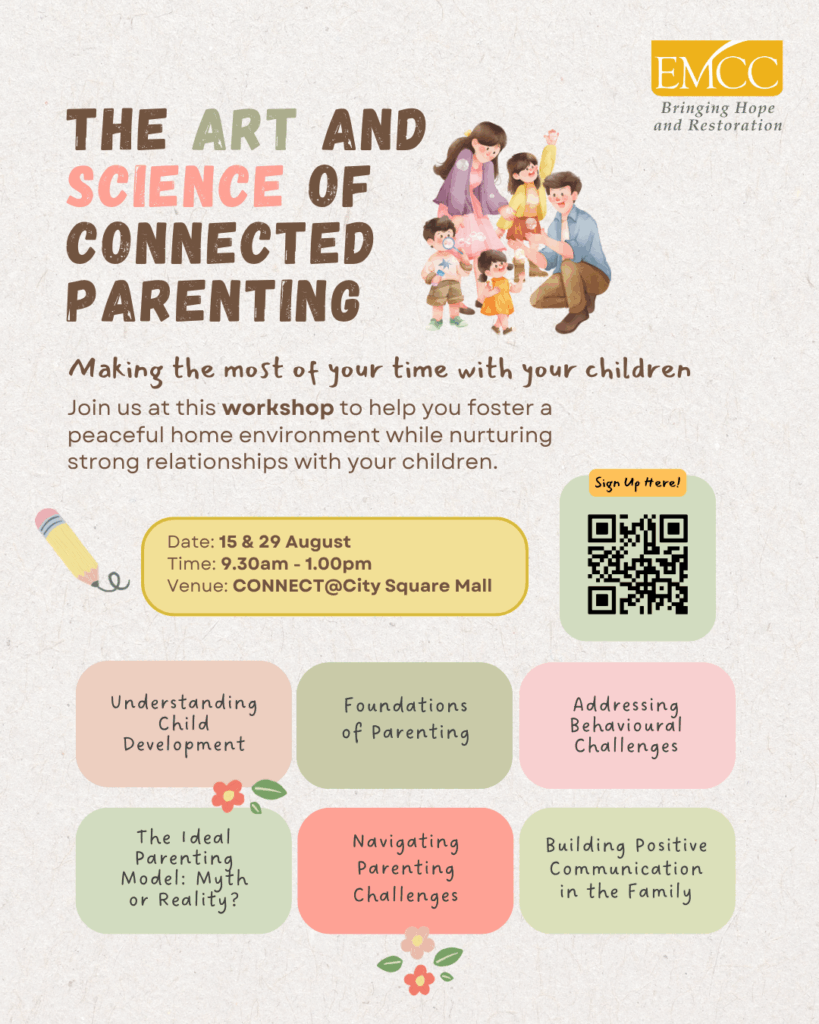
EMCC’s Parenting Workshop this August are built around exactly this understanding. They bring together the Gottman research framework and practical tools for couples who are also parents, people navigating the beautiful, exhausting overlap between building a family and sustaining a marriage.
Because your children don’t just need present parents. They need parents who are present with each other.
Before the school year picks up again, before August turns to September and the schedules stack back up, consider investing a few hours in the relationship your children are learning from most.
The garden metaphor is apt: you can’t pour everything into the fruit and leave the roots unattended. Both need tending.
EMCC’s Parenting Workshop: The Art and Science of Connected Parenting run in August.
Find out more and register here.