
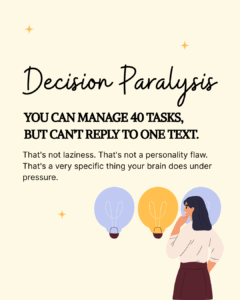
 The tab has been open for eleven days. It’s a dentist appointment. Two clicks to book. You’ve looked at it four times, closed it each time, and told yourself you’ll do it later.
Meanwhile, you’ve sent three reports to your boss, fielded fifteen Teams messages before 9 am, and made seventeen judgment calls at work…all without blinking. But the dentist tab? Somehow, that’s the one you can’t close.
This is not laziness. This is not avoidance in the way people mean it dismissively. This is your brain doing something very specific, and once you understand what it’s actually doing, the self-criticism starts to feel a little less warranted.
What decision paralysis actually is, and what it isn’t
Most people have heard the Paradox of Choice argument: too many options overwhelm us, so we freeze. Barry Schwartz’s research showed that when people are given more jam flavours to sample, they’re actually less likely to buy anything.
True enough. But that’s almost too tidy an explanation for what most high-functioning people experience.
Decision paralysis, in the way it tends to show up for overloaded, high-achieving adults, isn’t primarily about too many choices. It’s about what happens when your brain’s threat-detection machinery starts treating ordinary decisions as potential danger.
The prefrontal cortex, aka the part of your brain responsible for planning, weighing consequences, and making considered choices, gets progressively suppressed when you’re operating under sustained stress.
What floods in instead is the more primitive, reactive part of your brain:
- Faster
- More emotionally driven
- More concerned with not getting it wrong than with getting it right.
So decisions don’t feel like decisions anymore. They feel like risks. And the safest response to a perceived risk is often to do nothing at all.
Why you’re having a brain freeze
The freeze response doesn’t belong only to dramatic moments.
Researchers studying allostatic load, which is the cumulative physiological cost of prolonged stress, have found that living at a sustained high-pressure baseline rewires how the brain responds to demands over time.
The system doesn’t distinguish well between “I have to present to the Board in an hour” and “I need to pick a restaurant.” Both get processed through the same frazzled architecture.
If you’ve spent years in environments where mistakes had real costs, such as:
- A family where nothing was ever quite good enough
- A school system that sorted you by your failures
- A workplace that moved fast and punished wrong calls
…it becomes natural that your brain may have learned to treat uncertainty itself as threatening.
Not because you’re broken, but because it’s adaptive. Hesitation protected you once. The problem is that the brain is slow to update its threat register when the actual danger has passed.
Years of research have confirmed that even moderate, uncontrollable stress can significantly impair higher-order thinking. The brain under pressure defaults to well-worn neural paths — habitual responses, avoidance, inaction. The very cognitive flexibility that decision-making requires gets dialled down precisely when you need it most.
Where it shows up (and you’re probably not clocking it as stress)
Here’s the tell: it’s rarely the big decisions that reveal the pattern. It’s the small, silly ones.
You might find yourself:
- Staring at a food delivery app for twenty-five minutes and then ordering what you always order
- Reading a WhatsApp message and leaving it on read for three days because you can’t figure out the right thing to say
- Scrolling through Netflix for forty minutes, choosing nothing, and going to bed
- Starting five different things at work and finishing none because committing to one feels like giving up on the others
This is decision paralysis operating below the radar.
And because the decisions themselves seem trivial, the paralysis doesn’t get named as anything. It just becomes evidence that you’re disorganised, or lazy, or “bad at making decisions.”
None of which is the actual story.
What strategies actually help (besides telling yourself to just decide)
- Create Some Distance from the Thought
The most useful reframe here is one borrowed from Acceptance and Commitment Therapy: cognitive defusion.
Instead of trying to push past the paralysis with willpower, you observe it from a small distance.
“I notice I’m treating this as if it matters more than it does.”
Not dismissing the feeling. Just loosening its grip. The decision doesn’t shrink, but the threat around it does.
- Use a Decision Window
Some psychologists recommend creating a short, fixed time period in which you make the call and move on, regardless of whether it feels like the right one.
For example:
- Five minutes for low-stakes decisions
- Decide within the window
- Move on once the decision is made
The point isn’t accuracy.
It’s practising the tolerance of imperfect outcomes. The brain learns that choosing and surviving is safe territory.
- Lower the Reversibility Bar
Most decisions that feel permanent aren’t.
You can:
- Cancel the appointment
- Change the order
- Reply and clarify later
Labelling a decision as reversible, explicitly and out loud, reduces the cognitive load enough that the prefrontal cortex can actually do its job again.
None of these fix the situation overnight
Decision paralysis tends to ease when the underlying load eases. That’s the unglamorous truth.
But understanding the mechanics gives you something, i.e., it shifts the narrative from “I’m someone who can’t get their act together” to “I’m someone whose brain is running a protection response that’s currently misfiring.”
That’s not an excuse to opt out of adulting. It’s just a more accurate story. And accurate stories, it turns out, are a much better starting point than punishing ones.